
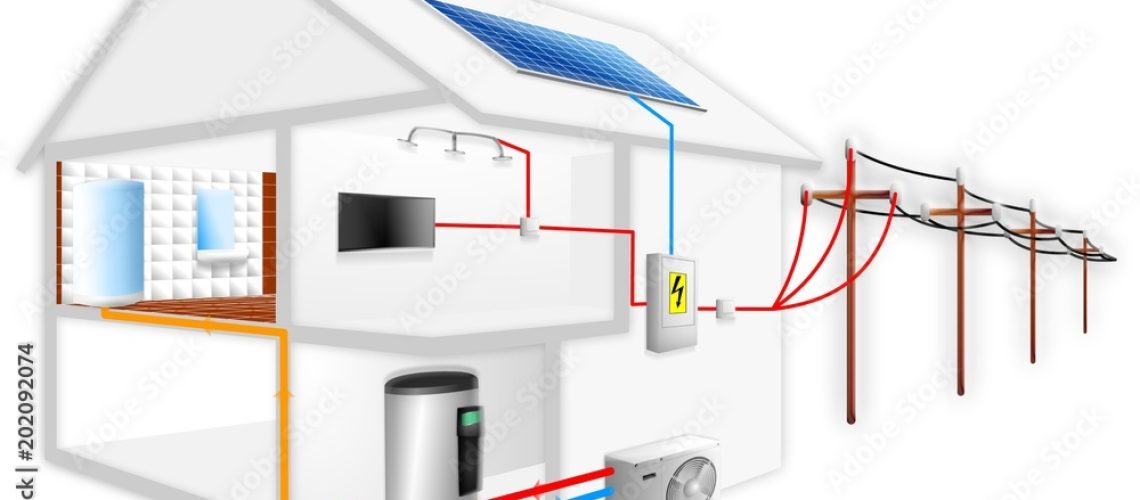
Air source heating from heat pumps is a low carbon, cost effective way of providing your home with hot water and central heating.They are a great replacement for central heating systems that are costly to run such as electric storage heaters, LPG (Liquid Petroleum Gas), oil or coal powered central heating. They can be a very good choice for people who live in remote areas that rely on oil or gas deliveries that they store on site.
What is Air Source Heating?
Air Source Heating is a modern, environmentally friendly way of heating a home. The system uses what’s called an Air Source Heat Pump to take heat from the air and make it warmer using a compressor. The heat from the air is transferred to your home’s heating system.
How does an air source heat pump work?
They are a bit like refrigerators in reverse.
- A large fan pulls in air and blows it over an element containing a liquid refrigerant. Like the the cooling system in your ‘fridge, this liquid boils at a very low temperature so even what we think of as cold air is enough to turn this liquid into gas.
- This warmed up gas is then compressed, which increases the temperature – think of when you pump up your car tyres and the air hose gets hot, this is the same principle.
- The unit then pumps this hot gas into a heat exchanger – basically a hot water tank with an element similar to what’s in your kettle. This hot water will be pumped into your radiators, with what’s left over being stored for your hot water for baths and showers.
- The refrigerant is now cold and turns back into a liquid and is circulated back to the heat pump to start the process again.
The difficult bit to grasp is how, even on a freezing cold day, an air source heat pump still creates hot water. They work even if it’s sub zero outside, so even when the garden is frosted up in the deep, dark winter the temperature difference between the air and the liquid refrigerant is enough to provide piping hot water all day.
Is Air Source Heating Difficult to Install?
While this sounds like a complex system, an air source heating system can be installed in your home quickly and without too much disruption.
Firstly you will need to have the unit installed outside your home. It’s basically a big fan in a box, and while they aren’t terribly pretty, they aren’t an eyesore outside of your home. Most people put them round the side or the back of their homes where they don’t have to look at them all the time. It’s a good idea though to put it as close to the hot water tank as possible to stop heat from escaping the pipes that take the refrigerant to and from the tank.
This fan-in-a-box, though quite large (around 50cm tall and 70cm wide), they are very quiet and you wouldn’t notice one running outside of your living room window.
There is then a piping system for the refrigerant. This is just 2 pipes that circulate the coolant between the compressor unit outside and the hot water tank in the house. As said earlier, the shorter this distance the better to prevent heat loss before the heated gas reaches the water tank.
The water tank will replace your existing one (if you have one) and go either in your airing cupboard, or in the loft. You won’t need to replace your existing pipe work, but you may need larger radiators because air source heating produces runs at a lower temperature to standard central heating. It’s more about maintaining a constant, comfortable temperature rather than having an expensive, high temperature blast twice a day.
Connecting the Heat Pump to the electricity supply is a simple enough job, and they don’t take much power to run. Some people remove even this low expense by running their heat pumps from solar power.
Conclusion
Hopefully you understand a little more about Air Source heating and how they work.
